
The Sefton Offer: the THRIVE Model – What our Children and Young People need, when they need it

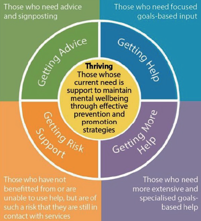
In Sefton we have moved mental health and emotional wellbeing services away from the traditional tiered service model to the THRIVE model - a national model based on needs of young people, rather than severity or diagnosis, and the support or evidence-based treatment they need to thrive and enjoy positive mental health and wellbeing. This way of working aims to ensure more children and young people can get access to the right help when they need it from a wider range of services and locations.
The THRIVE Framework provides a set of principles for creating coherent and resource-efficient communities of mental health and wellbeing support for children, young people and families. It aims to talk about mental health and mental health support in a common language that everyone understands.
The Framework is also needs-led - this means that mental health needs are defined by children, young people and families alongside professionals through shared decision making. Needs are not based on severity, diagnosis or health care pathways. The THRIVE Framework conceptualizes the various needs of children, young people and families into five needs-based groupings. This model can give local schools a guide to follow for a graduated approach to providing our young people with the support they need at the appropriate level when they need it.
An example of this is from Holy Family Catholic High School who stratify student needs into risk levels, enabling a proactive, data-informed response. Key elements of this implementation include:
■ Risk Assessment and Monitoring: Students monitored by the Inclusion Centre are assessed against CAMHS risk levels. Fortnightly multidisciplinary meetings alternate between high and medium-risk cases, ensuring close monitoring, progress reviews, and forward planning.
■ Early Signposting and Support: Before Inclusion Centre referral, students and families are guided by Progress Leaders to local and national support services via their website. This includes signposting to Kooth, Sefton services, and access to their Wellbeing at Lunchtime programme, boxing therapy, or the school nurse.
■ The Wellbeing Challenge: Students engage in a 30-day Wellbeing Challenge built around the Five Ways to Wellbeing. This not only fosters resilience and self-reflection but provides valuable insights for staff to determine next steps and initiate meaningful conversations.
■ Tailored Early Interventions: Students requiring further support receive targeted provision, either 1:1 or group-based.
Options include:
• Weekly check-ins with a learning mentor
• A Confident Me: Teen Programme (programme externally bought in, delivered in house)
• Psychoeducational support from MH Lead and the Sefton Mental Health Team
• ELSA-led interventions
■ Access to Specialist Services: If additional needs persist, students are referred to in-school counselling or external agencies within Sefton’s local offer such as Rise Up, Parenting 2000, SWAN, Venus, and The Star Centre.
Many interventions will not be thought of as improving mental wellbeing, but the 2 case studies
below help to provide safe, calm, supportive and inclusive leaning environments. One aims
specifically to help deal with the negative impacts of poverty.

The Garden Room Case Study
“In response to the local and national challenges we are experiencing with the mental health of our young people a solution focused approach was taken to address this. Colleagues at Meols Cop worked through an extensive implementation strategy to launch what is now the ‘Garden Room’. The Garden room is an -site provision for students who have gone through a graduated process and experiencing significant attendance challenges due to mental health. The provision has a structured entry experience for students and families, a purposeful therapeutic focused curriculum and personalised exit strategies for reintegration back into school or college. Through the investment in a purposeful learning environment, well-trained full-time staff, strategic engagement with external partners and importantly the flexibility to engage in all key elements of the mainstream school we are seeing significant impact for the young people and the families.
Importantly the Garden Room is much more than just a room. The extensive strategic focus on this provision as a key part of the wider culture of the school ensures that lethal mutation does not occur and the impact of the provision continues to be evidenced in increased school attendance, positive impact on outcomes for these students and
importantly keeping them of extensive waiting lists for support as they move through life”

Sefton’s Child Poverty Strategy Case Study
“The Child Poverty Strategy has successfully galvanized support and momentum from a wide variety of partners. Through developing the strategy around a focus on ‘pockets, prospects and places’, stakeholders across all sectors are now embracing the opportunity to play a key role in tackling child poverty in Sefton. The strategy highlights the clear advantages of implementing pro-equity and anti-poverty changes to the way we do things in Sefton, with clear benefits for organisations and communities as well as individual children and families.
Sefton Council’s Public Health team are working in partnership with Children North East (CNE) to introduce Poverty Proofing© approaches to partner organisations and settings in Sefton e.g., Poverty Proofing© the School Day (PPSD) and Poverty Proofing© Culture. A Poverty Proofing© Healthcare programme is also planned in Primary Care. Developed by CNE, these programmes are exemplars of hands-on, practical, sector-led approaches to changing the way that diverse services and opportunities can be resourced, designed, and delivered with disadvantaged children front of mind. The ‘prospects’ priority is about tackling the causes of the education and income gaps and providing better routes out of poverty for parents and children.
The relevance of child poverty is the negative impact it has on pupils’ educational attainment, their wider wellbeing, and future life chances. Sefton schools are at the forefront of the cost-of- living crisis so adopting a Poverty Proofing© approach to the school day provides a structured way to minimize school costs and to increase pupil participation in all aspects of school life”