
The Sections of THRIVE in Sefton

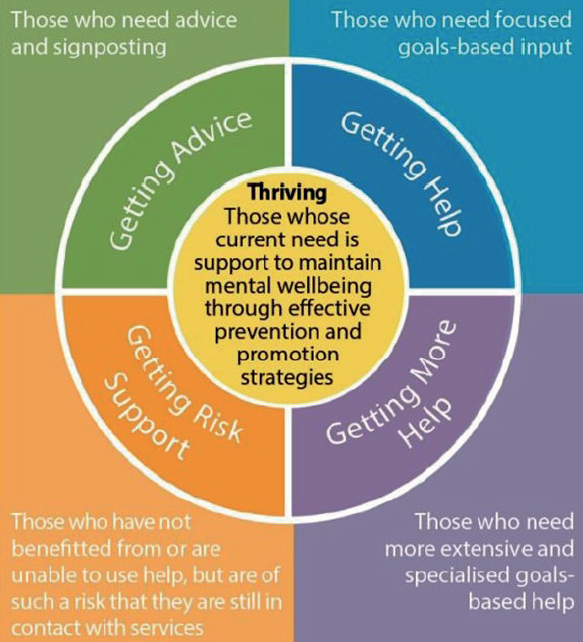
Figure 3: The THRIVE Model
Thriving
Promotion and prevention strategies universally provided and available to help people maintain their own and their families’ emotional health and wellbeing. This can include campaigns,
awareness raising in schools, the activities of health visitors and having a safe borough for our young people to grow and feel empowered and in control of their emotional health and wellbeing. Other examples of what keeps our young people in the “thriving” space can include our green spaces and coastal areas providing the opportunity to enjoy nature, socializing with peers and learning in our safe education settings. Please see the 2024 Public Health Annual
Report for some case studies of our young people using these spaces and other activities to keep themselves well. The “thriving” space is one where our young people are not experiencing the majority of negative variables outlined in Figure 1.

Case study example: Windmills
Windmills are a local organization helping to create a thriving space. They focus on a young persons “social signature”. These are the actions, kindness, and contributions which shape the legacy you leave behind. Sefton Social Signature is a movement which empowers young people to thrive by caring for themselves, their community and the world around them. Across Sefton, over 3000 4–18-year-olds
Social Signature mark makers have co-created a map of ‘24 Ways to Make Sefton a Better Place’. They have impacted on areas including health, relationships, safety, poverty, learning and the environment.
Young people have spread SMILEs across their neighbourhoods in partnership with Sefton CVS, Sefton Council and local charities. These Social Signature Smiles have ranged from intergenerational beach cleans, homeless wellbeing packs and anti-knife crime runs to recording songs for children’s charities, first aid training, buddying up programmes, volunteering and random acts of kindness.
In giving back, connecting, exercising, appreciating and learning new things, these young people have significantly enhanced their levels of health and wellbeing. 98% have grown in confidence; 96% now feel better connected with their community: 95% have increased their contribution the place they learn and live in; and 97% feel more hopeful about their futures.
Windmills’ vision, with support from the Prince of Wales, is to take a proactive approach to mental health and well-being by helping every child in the country to leave their Social Signature legacy before leaving primary school. Helping them to understand it’s not the marks you get in life that count, it’s the marks you leave.
Figure 4: The Social Signature
Case study example: Summer Holiday support for children and young people with Special Educational Needs.
This is a coordinated piece of work with support from multiple partners including SEND, Children’s Social Care, School Health, Mental Health Support Teams, School teachers and Teaching Assistants, Green Sefton, Liverpool Football Club, Crosby Plaza Cinema, Sefton at Work and Sefton Welfare Rights. School events were arranged and
attended across Formby, Southport, Maghull and Bootle school clusters. Recently approximately 60 families attended weekly 4 hour sessions, with over 100 children present. Feedback from families and professionals showed the support provided safe spaces, activities, information sharing, sensory play, preparation for the coming school term, making friends and supporting parents ‘mental health’.
The atmosphere at the events was extremely positive and several parents and children said that these days were the best days they had all Summer. Several families said that these support days represented their only real opportunity to get out at all. Families and professionals all noted how the children thoroughly enjoyed sensory play opportunities and grew increasingly sociable and confident as they enjoyed safe consistent support in these settings. Every feedback form stated that both families and professionals would like to see more of these sessions in place across future school holidays.
Getting Advice
Many children and families will at some time need advice and signposting so that they can access information and support for self-management of their emotional and mental health, or need a one off or short term contact. This is available to all families and children (although may be some age limits). This can include support and advice provided via the local Emotionally Based School Avoidance (EBSA) Toolkit which can be found here
The focus for services at this stage of the THRIVE model is having staff aware of what is available in Sefton to offer the best advice on where a young person could go to get support at this early stage in worrying about their mental wellbeing. This requires resource to train staff and to keep them up to date on the Sefton offer. It can also be challenging to have a standardised approach to ensure a “no wrong front door” way of working.
Case study from a local education setting:
Katy disclosed to her tutor that she was feeling lonely and anxious since starting college. Katy was offered a weekly catch up session with her tutor and was signposted internally to the college’s friendship group. Katy was also taken to the college’s enrichment hub, where she was able to access a variety of sporting activities, craft groups and mindfulness sessions. Katy was supported to sign up to Kooth, where she was able to access a plethora of psycho education, plus online counselling if required. Katy consented to her Mum being contacted by her college tutor, information was shared with Mum and advice given around how to effectively manage anxiety and things that may be helpful.
Getting Help
When identified emotional health and wellbeing needs impact on the functioning of or risks to a child or young person – outcome focused, evidence based low-level interventions may be required. Based on the identified need these evidence based interventions can include group
work, drop- in sessions, targeted class support, multi-agency working and 1:1 sessions.
This is the earliest point where a therapeutic intervention may be required to help the young person cope better with their individual needs; where more structured and focused support is required
compared to simply receiving advice or signposting.
Case study from Parenting 2000:
15 year old young person with experience of ACEs and family conflict was referred for counselling sessions by their parent. The young person had low mood, fatigue, a sense of ‘emptiness’ and feelings of irritability. Some challenges included friendship issues, education/ exams, also physical health and wellbeing with a desire for more energy and motivation. The young person wanted to improve their emotional wellbeing, building resources and resilience and feeling hopeful for a positive future. The client accessed 6 Person Centred Counselling with Expressive Arts Therapy (PC-EAT) sessions;
integrating creative, emotion focused and somatic therapeutic activities. The outcome was a recorded decrease in levels of anxiety and depression. They had increased energy, greater self-care and compassion, emotional awareness, connecting to values and choices with personal agency and decision making. They expressed a
new focus on enjoyment of milestones ahead e.g. attending prom, accessing college, volunteering and work opportunities, and beyond this, independent living as well as new friendships.
Getting more Help
Children and young people with more complex issues related to their mental health will need more extensive and specialised goals-based support. This will need to be provided by staff with specific skills and qualifications and be based on clinical and evidence based treatment
models. It will also involve case management, risk and safety planning and medication. Targeted interventions can include cognitive behavioural therapy, non-violent resistance parenting approaches, Systemic Family Practice, Riding the Rapids, Incredible Years etc. It should also be noted that group work and self-management can play an important part in supporting and ‘treating’ children and young people with this level of need.

Getting Risk Support
Not all children and young peoples’ mental health needs will be identified before they present in crisis. For some children and young people even though they are already being supported and
‘treated’, risk can still escalate so that urgent and crisis management is required. These children and young people, their families and frontline services need to access timely support in the management of the crisis and risk being presented.
A few examples of agencies:
■ Crisis Team
■ CAMHS
■ Children’s Social Care
■ Gateway Team
■ Alder Hey mental health services